
KIOXIA CM7-R Series (2.5-inch)
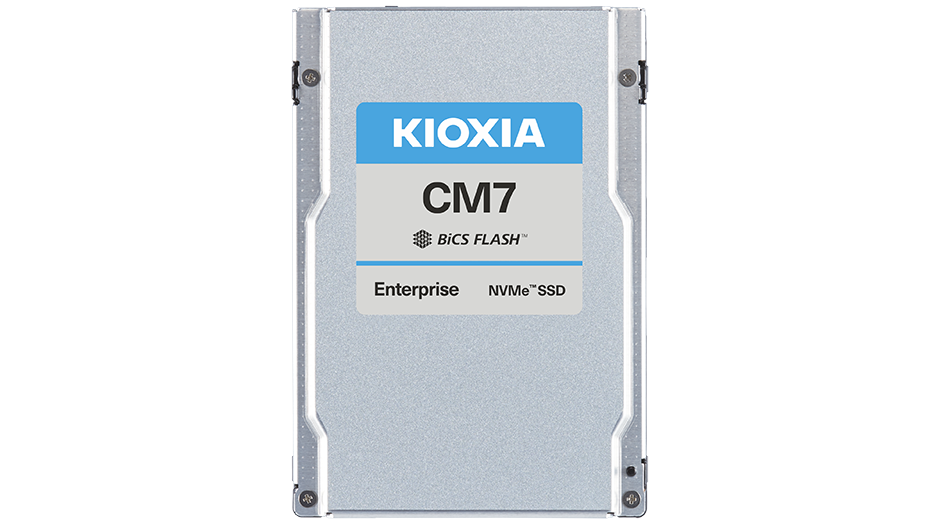
|
Enterprise NVMe™ Read-intensive SSD KIOXIA CM7-R Series is a read-intensive SSD that is optimized to support a broad range of enterprise applications and associated workloads, including business intelligence, online transaction processing, and software defined storage and virtualization. Built on PCIe® 5.0 (for U.3 host: PCIe® 4.0) and NVMe™ 2.0 technology, the CM7 Series SSDs deliver excellent performance up to 2,700K IOPS (random read) and 310K IOPS (random write). Featuring KIOXIA 112-layer BiCS FLASH™ 3D TLC flash memory, the CM7-R Series of enterprise NVMe™ SSDs delivers 1 DWPD (Drive Writes Per Day) of endurance and support storage capacities up to 30.72 TB, making them ideally suited for read-intensive enterprise applications. |
|
Key Features |
|
|
|
Key Applications |
|
|
|
Specifications
* Table can be scrolled horizontally.
| Base Model Number | KCMY1RUG30T7 | KCMY1RUG15T3 | KCMY1RUG7T68 | KCMY1RUG3T84 | KCMY1RUG1T92 |
|---|---|---|---|---|---|
| Capacity | 30,720 GB | 15,360 GB | 7,680 GB | 3,840 GB | 1,920 GB |
| Basic Specifications | |||||
| Form Factor | 2.5-inch, 15mm thickness | ||||
| lnterface | PCIe® 5.0, NVMe™ 2.0 | ||||
| Maximum Interface Speed | 128 GT/s (PCIe® Gen5 single x4, dual x2) | ||||
| Flash Memory Type | BiCS FLASH™ TLC | ||||
| Performance in single port (1x4) mode (Up to) | |||||
| Sustained 128 KiB Sequential Read | 10,000 MB/s | 14,000 MB/s | |||
| Sustained 128 KiB Sequential Write | 4,900 MB/s | 7,000 MB/s | 6,750 MB/s | 3,500 MB/s | |
| Sustained 4 KiB Random Read | 1,600K IOPS | 2,400K IOPS | 2,450K IOPS | 2,700K IOPS | 2,000K IOPS |
| Sustained 4 KiB Random Write | 150K IOPS | 300K IOPS | 310K IOPS | 155K IOPS | |
| Power Requirements | |||||
| Supply Voltage | 12 V ± 10 %, 3.3 V ± 15 % | ||||
| Power Consumption (Active) | 25 W typ. | 22 W typ. | |||
| Power Consumption (Ready) | 5.5 W typ. | 5 W typ. | |||
| Reliability | |||||
| MTTF | 2,500,000 hours | ||||
| Warranty | 5 years | ||||
| DWPD | 1 | ||||
| Dimensions | |||||
| Thickness | 15.0 mm +0 / -0.5 mm | ||||
| Width | 69.85 mm ± 0.25 mm | ||||
| length | 100.45 mm Max | ||||
| Weight | 130 g Max | ||||
| Environmental | |||||
| Temperature (Operating) | 0 °C to 72 °C | 0 °C to 73 °C | 0 °C to 76 °C | ||
| Temperature(Non-operating) | -40 °C to 85 °C | ||||
| Humidity (Operating) | 5 % to 95 % R.H. | ||||
| Vibration (Operating) | 21.27 m/s2 { 2.17 Grms } ( 5 to 800 Hz ) | ||||
| Shock (Operating) | 9.8 km/s2 { 1,000 G } ( 0.5 ms ) | ||||
- Product image may represent a design model.
- Definition of capacity: KIOXIA Corporation defines a megabyte (MB) as 1,000,000 bytes, a gigabyte (GB) as 1,000,000,000 bytes and a terabyte (TB) as 1,000,000,000,000 bytes. A computer operating system, however, reports storage capacity using powers of 2 for the definition of 1GB = 2^30 = 1,073,741,824 bytes and therefore shows less storage capacity. Available storage capacity (including examples of various media files) will vary based on file size, formatting, settings, software and operating system, and/or pre-installed software applications, or media content. Actual formatted capacity may vary.
- GT/s: Giga Transfers per second.
- A kibibyte (KiB) means 2^10, or 1,024 bytes.
- MTTF (Mean Time to Failure) is not a guarantee or estimate of product life; it is a statistical value related to mean failure rates for a large number of products which may not accurately reflect actual operation. Actual operating life of the product may be different from the MTTF.
- DWPD: Drive Writes Per Day. One full drive write per day means the drive can be written and re-written to full capacity once a day every day for the specified lifetime. Actual results may vary due to system configuration, usage and other factors.
- Read and write speed may vary depending on various factors such as host devices, software (drivers, OS etc.), and read/write conditions.
- IOPS: Input Output Per Second (or the number of I/O operations per second).
- Temperature (operating): Specified by the composite temperature reported by SMART.
- [1] The Sanitize Instant Erase (SIE), Self-Encrypting Drive (SED) and FIPS (Federal Information Processing Standards) SED optional models are available.
- [2] SIE optional models support Crypto Erase, which is a standardized feature defined by the technical committees (T10) of INCITS (the InterNational Committee for Information Technology Standards).
- [3] SED optional models support TCG Opal and Ruby SSCs. It has a few unsupported TCG Opal features. For more details, please make inquiries through “Contact us”.
- [4] FIPS SED optional models utilize a security module designed to comply with FIPS 140-3, which define security requirements for cryptographic module by NIST (National Institute of Standards and Technology). For the latest validation status, please make inquiries through “Contact us”.
- [5] Optional security feature compliant models are not available in all countries due to export and local regulations.
- All information provided here is subject to change without prior notice.
- PCIe is a registered trademark of PCI-SIG.
- NVMe is a registered or unregistered mark of NVM Express, Inc. in the United States and other countries.
- Other company names, product names, and service names may be trademarks of third-party companies.


